
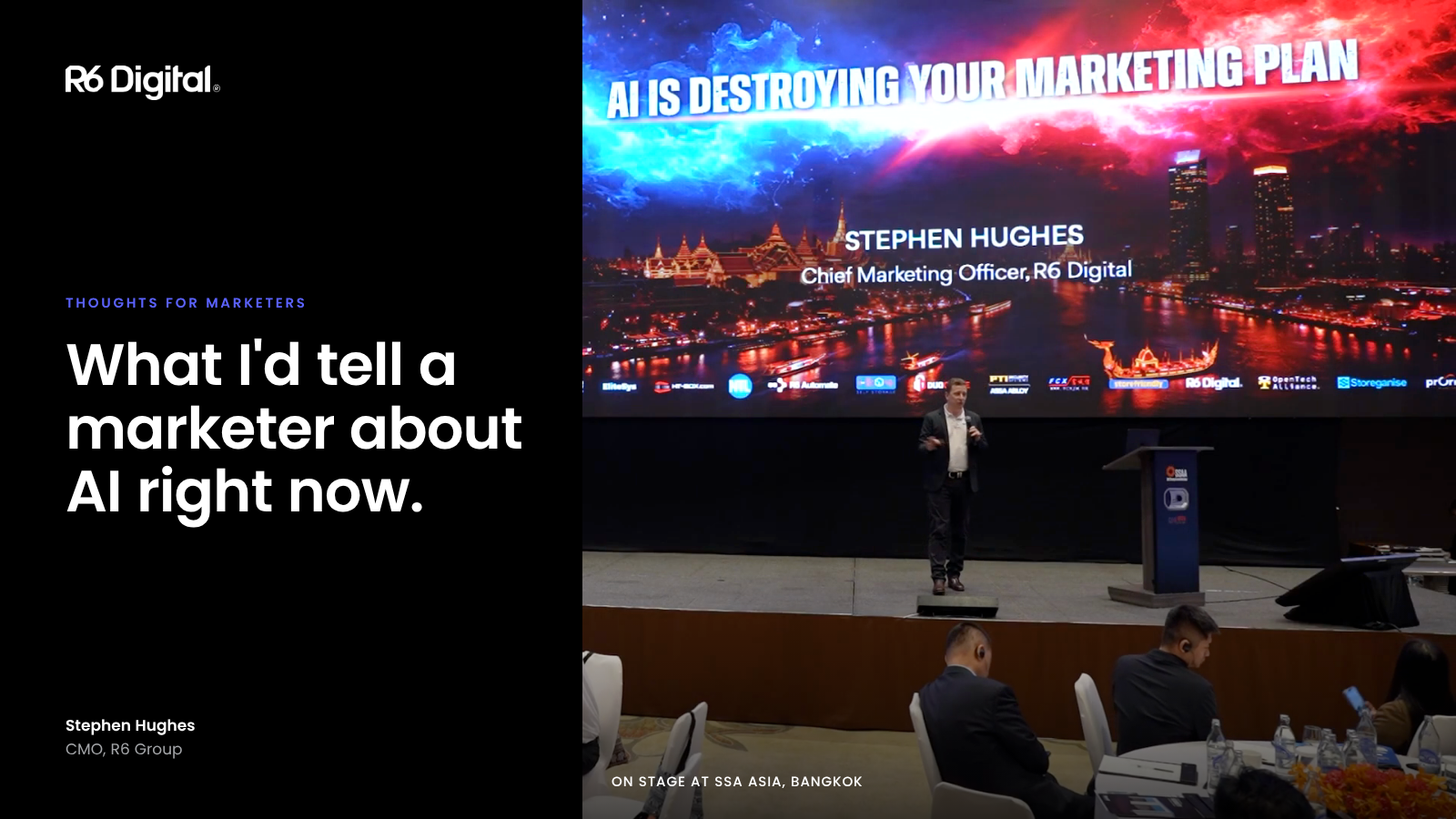
What I’d tell a marketer about AI right now
I use AI all day, every day. Sometimes I forget that most people don’t.
I recently asked my LinkedIn network how confident they feel with AI. The options ran from “AI superhero” to “where do I start?” That spread matches what I see in marketing teams too.
AI is the biggest shake-up to marketing I’ve seen in my career. The closest thing was Google eating classified advertising. For a marketing geek like me, that’s pretty exciting. It also means a lot of the playbook we relied on is moving under our feet.
I covered a lot of this in my talk at the Self Storage Association Asia conference in Bangkok. You can watch the full talk on the R6 Digital YouTube channel.
Here’s where I’ve landed for now. Some of it will date quickly, and that’s fine. That’s the nature of this space.
1. Your website isn’t the main source any more
Zero-click search is where a big chunk of top-of-funnel traffic has gone. People get their answer in an AI Overview or in ChatGPT and never click through.
That raises an obvious question. If AI search doesn’t drive many clicks, is it worth investing in? My answer is yes. The decision is still being made there. You just don’t see it in your analytics.
The catch is that LLMs don’t lean on your website as much as you’d hope. They pull from reviews, forums, directories, news and other people’s content about you. So your GEO (generative engine optimisation) strategy needs both on-page and off-page work to be complete.
The sources also shift fast. Earlier this year I told a conference room in Bangkok that Reddit was hugely represented in ChatGPT answers. Not long after, Reddit citations dropped by around 80%. Don’t build your plan around one source. Aim to be well represented across lots of them.
2. Being mentioned isn’t the same as being recommended
Most GEO talk focuses on citations. That’s only part of the story.
Less than half of AI responses on the topics we’ve looked at carry positive sentiment, across both Gemini and ChatGPT. The rest are neutral or negative. A horrifically bad business can get plenty of citations… telling people how bad it is.
So set two goals: visibility and sentiment. Track only one and you’re missing half the picture.
3. Fresh content matters more than it used to
Google always cared about content freshness. LLMs take it to the next level. We saw this play out in testing with a client in the self storage industry.
If your best pages haven’t been touched in two years, put them on a refresh schedule. Start with the pages that answer the questions your customers actually ask.
4. ChatGPT ads are display ads, not search ads
We’ve been testing ChatGPT ads, like most marketers. One of my team summed up the early results well: “It’s paying Google Ads dollars for cheap display quality traffic.”
Here’s my theory on why. In Google Search, a paid ad sits on a fairly even playing field with the organic listings. Nothing in the layout says one option is better than another. In ChatGPT, the platform passes judgement on the options based on what the person asked for. Its answer will always feel more authoritative than your ad sitting next to it. You start from behind.
I can see two ways it might work. You could treat it as a display channel, although right now it’s too expensive for that. Or you could use tight targeting to nudge people who are already close to converting. That works best if ChatGPT is already saying good things about you.
For my money, GEO exposure and sentiment are the better investment right now. I’ll keep testing, and I’m happy to eat my words if that changes.
5. Do the boring data work first
Everyone wants to talk about the sexy AI projects. Far fewer people want to talk about data. But the old rule still applies: crap in, crap out.
At R6AI we worked with a law firm running nine AI tools. The number of tools wasn’t the problem. Years of client records, entered by different people in different ways, was the problem. Every tool they built inherited that mess.
Marketers know this one well. Five spellings of the same suburb. Multiple names for the same product. Before you spend time and money on your next AI tool:
- Review the one dataset the project will rely on
- Fix the fields that matter and delete the ones that don’t
- Set one rule for how data gets entered from now on
- Use AI to clean and standardise what’s already there
It’s not glamorous. It will make a huge difference to how your next AI project performs.
6. Split the work from the value add
When you can automate almost anything, how do you decide what to leave with people?
I break a role into two buckets: work and value add. Work tasks only need to be done accurately and on time, and AI and automation handle that well. Value add tasks are where a person brings something extra. Think creativity, personality, relationships and tricky problem solving.
Set up your workflows so your people spend their time in the second bucket. In marketing, that’s usually strategy, ideas, client conversations and taste.
7. AI writes the first draft. You make the call.
Anyone can get AI to write something. Getting something good every time is a skill.
A few habits make the biggest difference. Tell it who you are and who you’re writing for. Say what you don’t want, because constraints often do more than instructions. Ask for twenty headlines when you need one. Generating is cheap, and choosing well is the real work. Then check every fact before it goes out, because AI sounds confident even when it’s wrong.
There’s one step most people skip. Once you’ve finished editing, give your final version back to the AI. Ask it to compare its draft with what you actually used. Make that part of your normal workflow and its drafts will get closer to your voice much faster.
What you don’t want is to become a “meat proxy”. I heard the term in a meeting recently. It’s someone who pastes an email into Claude, then pastes the reply straight back without reading it. Your audience can tell, and so can your clients.
8. Prototype before you build
This is the one I’m most excited about.
The Mechanical Turk toured from 1770 as a chess-playing machine that could beat almost anyone. In reality, a chess master was hidden inside, moving the pieces with levers and magnets. Years ago a colleague used it to explain “pretotyping”: fake the product first to test whether anyone wants it.
AI has taken that idea to another level. We now build limited working prototypes of new ideas, products and features in Claude. We put them in front of customers and prospects, get feedback and test the market before we invest in building anything properly.
For marketers, that changes the pace of testing. A landing page concept, a calculator or a new offer can be in front of real people in days, not quarters.
Where to start
If you’re at the “AI curious” end of the scale, don’t start by comparing tools. Pick one task you do every week and ask whether it’s work or value add. If it’s work, that’s your first experiment.
And if you’d like a second opinion on where AI fits in your marketing, give us a yell.
Share on


