
2026 Digital Marketing Trends: What You Need To Know
It’s a pretty exciting time to be in Digital Marketing.
Over the past year alone, we have seen many great changes, AI is becoming more prominent in our advertising, consumer behaviour has changed on the internet, and the algorithms are shifting. But underneath all of that, what’s really happening is that the businesses who show up with the right strategy are getting better results than ever before, and the gap between them and everyone else is growing.
The pace of change in technology has never been faster. What once took decades to reach mainstream adoption is now happening in months. For example, according to Deloitte’s article highlighting the Tech Trends of 2026, the telephone took 50 years to reach 50 million users, while a recent generative AI tool took two months to reach twice that amount of users.
R6 Digital has been doing this for 24 years. We’ve seen the rise of social media, the mobile revolution, the death of organic reach, and about a dozen other shifts that were supposed to change everything. And what we’ve learned is that the businesses that lean in, stay curious, and get the right support tend to come out the other side stronger.
So here’s our honest take on what’s changing in 2026; what we’re seeing across our own clients’ campaigns, and what it actually means for your business.
User Behaviour & The Internet
Let’s start at the very beginning because everything else builds on this. The way your customers find information, discover businesses, and make decisions online looks quite different today than it did even 12 months ago. Understanding that shift is the foundation of any good digital strategy.
“Conversational” Search
With the introduction of AI, especially Google’s AI Overviews, people are now getting used to getting their answer within seconds. Searches become less about wading through pages of links to find the answer. Tools like ChatGPT, Claude, and Gemini are working alongside traditional search engines to become a part of how people research. People are typing questions the way they’d ask a friend, and are expecting the same kind of response back.
Along with the essence of wanting an answer in seconds, short-form videos have become the creative of choice to appeal to viewers. It dominates because it respects the viewer’s time and gets to the point fast. The businesses that lead with value are the ones that are cutting through.
Social Platforms as Search Engines
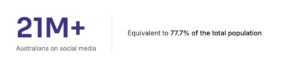
According to DataReportal’s Digital 2026 Australia report, over 21 million Australians are active on social media and for the younger audiences, search is becoming increasingly popular through social media platforms. Gen Z are spending more time on Instagram, YouTube and TikTok, and are using these platforms to validate your business. The practical implication for any Australian business: showing up well on search alone isn’t enough anymore. Your customers are forming opinions about you before they ever visit your website.
But along with this, not everyone behaves the same online. Gen Z and Millennials are on TikTok and Reels. Gen X is split across Google, Facebook, and digital news. Boomers still lean on search, email, and Facebook. A strategy that works brilliantly for one audience can completely miss another. Knowing your customer, and where they actually spend their time, isn’t a nice-to-have in 2026. It’s the whole game.
AI In Digital Marketing: Its Power & Limitations
Here’s the thing about AI that doesn’t get said enough; it’s genuinely remarkable, but it also has some pretty significant blind spots.
AI is now baked into almost every major marketing platform. It can do things that would take a human team weeks to replicate manually. Nearly 50% of marketers are now using AI for creative testing and bid optimisation, and it’s not hard to see why. Where a team might test two or three ad variations at once, AI can test hundreds simultaneously, learning in real time what’s resonating and giving marketers like us good insights to shift budget and strategy accordingly.
But with its good, comes its limitations. It has no access to the human or cultural context behind a decision. The businesses getting the best results are those using AI for the invisible work, but keeping a marketing expert in touch with the visible work: strategy, creative direction, and brand judgement. One without the other is where things go wrong.
The Impact of AI in SEO
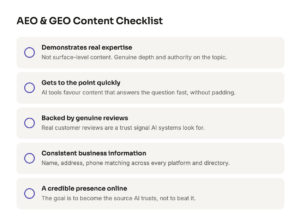
Traditional SEO is evolving into two new disciplines worth knowing about. Answer Engine Optimisation (AEO) is the practice of structuring your content so AI tools serve it as a direct answer to a user’s question. Generative Engine Optimisation (GEO) takes this further, optimising for how AI systems like ChatGPT and Gemini generate responses from across the web. Together, they change what good content looks like in 2026.
Thin, generic articles don’t make it into AI-generated answers. So what does?
Content that demonstrates real expertise, gets to the point quickly, and is backed by strong trust signals, including genuine reviews, consistent business information, and a credible presence online.
The goal isn’t to beat AI, but to become the source it trusts.
Google Ads in 2026
If you’ve been running Google Ads the same way for the past couple of years, it’s worth having a fresh look. The biggest shift is Performance Max campaigns. This AI-driven campaign type now runs across Search, Display, YouTube, Gmail and maps simultaneously, making decisions about who sees your ads, when, and where.
Done well, it’s genuinely powerful. However, it needs careful steering. Left completely to its own devices, it can spend budget in ways that look fine in the dashboard but don’t actually connect to your real business goals.
With AI overviews now also competing for space amongst Google Ads and SEO, the quality of your messaging and in some instances, creative, now matters more than it ever has in paid search. Google Ads in 2026 rewards active, strategic management. It rewards genuine, informed oversight from someone who understands both what the platform is doing and what it can’t account for on its own. We recommend having a Google Ads or Paid Media Specialist running your ads in 2026, whether that is internally or externally sourced.
Paid & Organic Social Trends
Social media has grown up. Platforms like TikTok, Instagram, Facebook, and LinkedIn are no longer just places to post content and hope people see it. They’re search engines, shopping destinations, advertising ecosystems, and community space, all rolled into one.
Paid Social: Your Creative Is Your Targeting Now
This has been a significant 2026 trend to hit Digital Marketing. Meta has fundamentally changed how ads are delivered. Thanks to AI-driven distribution, granular audience targeting matters far less than it used to. The platform’s AI now determines who sees your ad based largely on the creative itself. Specific, well-crafted content gets matched to the right people. Generic content gets delivered generically (and broadly, and expensively).
Investing in a creative variety is now more important than ever as it drives performance more than clever audience segmentation does. More creative, more angles, more testing.
User Generated Content
If there’s one content trend worth paying attention to right now, it’s this: authentic, user-generated style content is consistently outperforming brand-produced creative. This isn’t just an aesthetic preference, platforms are algorithmically rewarding content that looks like it belongs in the feed.
An upside for businesses? Your best performing content might cost less to make, not more. A genuine video from a real customer, a behind-the-scenes clip shot on a phone, or an honest product demo are often outperforming expensive productions. A simple test: does it look like something a real person would post? If it looks like a brand announcement, it’s probably working against you.
Platform Strategy: Be Intentional
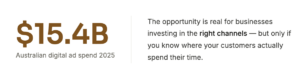
You don’t need to be on every platform. You need to be genuinely good on the ones that matter for your audience. For most Australian businesses that means Meta for reach and paid performance, TikTok for discovery and search behaviour among younger audiences, and LinkedIn if you’re in B2B or professional services. According to Meltwater’s 2026 Australian Social Media report, digital ad spend in Australia reached $15.4 billion in 2025, which tells you just how much opportunity exists for businesses investing in the right channels. Pick the platforms where your customers actually spend time, and show up well there rather than spreading yourself thin everywhere else.
What All of This Means for Your Business
2026 is genuinely one of the more exciting, and more complex times we’ve seen in Digital Marketing. The tools are better than they’ve ever been. The opportunities are real. And the businesses leaning into these shifts with a clear strategy are seeing it in their results.
The challenge is that the landscape is moving faster than most businesses can keep up with on their own. AI is making decisions inside your campaigns that aren’t always transparent. Platforms are evolving constantly. And the cost of an outdated strategy, wasted budget, missed audiences, content that falls flat, is higher than ever. That’s exactly where having the right expertise in your corner makes the difference.
If any of this has you wondering whether your current digital strategy is set up for where things are heading, that’s exactly the kind of conversation we love having.
Submit an enquiry with us today.
Check out our Digital Marketing services, here.
Sources: Deloitte Tech Trends 2026 · DataReportal Digital 2026: Australia · Meltwater Social Media Statistics Australia 2026
Share on


